
HUMAN AGAIN / Laurence Asa Lloyd Fountain
From complete system burnout to feeling HUMAN again.
A four-phase method for people who can lose fat by force, and have paid for it every time. Phase One builds the stability and health that make fat loss accessible, and fat loss can happen along the way. Phase Two is where it becomes the focus.
The whole of Phase One, in order: the method in the book, your numbers worked out in your own Claude account, and the signals that tell you when to move on. There is no fasting and no cutting carbohydrate.
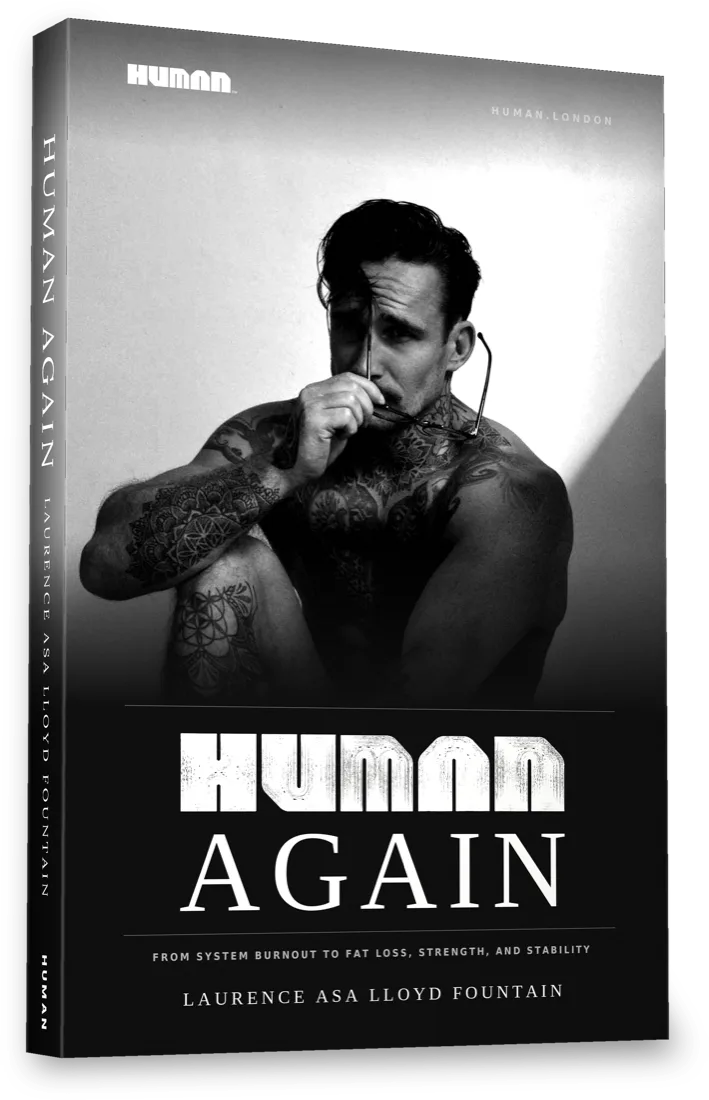
HUMAN AGAIN Opening soon
Be first to know when the book opens.
One email, on the day it opens. Nothing else.
If you have a history of an eating disorder, take insulin or other diabetes medication, are pregnant or are under 18, speak to your GP before changing how you eat.
- 4phases, taken in order, each with entry and exit signals
- 5tools in a guide that runs in your own Claude account. A free account is enough to start
- 2strength sessions a week once training returns
- Jan
2027the HUMAN app launches, free for readers of the book
Found us on Instagram? The post says comment HUMAN. The same details are on this page.

The cost
Has burnout started to show on you? Does every attempt at fat loss end a step further back?
01 The bill
You have spent your working life being the person who gets it done. A deadline tightens and you find the hours. A target rises and you rise with it. Somewhere in the years of doing that, force stopped being something you reach for and became something you are, so when you decided to get serious about your body, you did what has always worked. You applied more of yourself.
And it worked. Fat loss, on paper, is simple. Eat less, move more, sustain it long enough and body fat comes down. You are exactly the kind of person who can sustain it. But when fat loss is forced, the cost gets paid somewhere you were not watching: energy, mood, sleep, relationships, how clearly you think. It shows up as a shorter fuse at home, a head that keeps returning to food, a diary you run at the very edge of what you have. Energy narrows. Perspective shrinks. Life gets smaller.
Fat loss always works. The state you have to live in to get it is what takes you apart. And you have gone back to it every time.
The body loses fat, and it also loses capacity.
- Energy narrows
- Perspective shrinks
- Life gets smaller
- What changes is the Cost
That was never a verdict on your discipline. Your discipline held the deficit long enough for it to cost you, and the weight came back when the state you were holding it in ran out. For years your strength ran you, and it worked until it did not.
You already know most of this. You noticed it in who you were at the end of a hard week, and you pushed anyway, because pushing was the tool you had been handed. Eventually intelligence catches up, and there comes a moment where forcing it no longer feels strong. It feels careless.
That moment is where this book begins.
I always knew how to get it off and never keep it.
02 Read the opening
The opening of Part I.
Why Most People Fail, and Why It's Not Their Fault
Most people don't fail at fat loss because they lack discipline. They fail because they force a deficit onto a system already carrying all it can. Discipline can override biology for a while, and when it does, the cost can build quietly, in muscle, in recovery and in how you relate to food. There is a better way: a more hospitable set-up, where the process is easier to live with and kinder to your body.
By the time you decide to get serious, you're running low already. Time-poor, overloaded, under-slept, running on adrenaline rather than energy. But nothing seems obviously wrong. You're tired, and so is everyone. Life feels busy rather than broken.
Then you cut the calories and add the training, and within days everything is harder. Mood goes flat, or sharp, or both in the same afternoon. Food preoccupation, once occasional, becomes the background hum of the day.
That isn't coincidence. It's physiology. When stress stays high, whether from work, poor sleep, emotional load, broken routines, or years of failed attempts, the body shifts into conservation. Energy gets scarce. The brain turns protective.
The fat comes off. A deficit does that whatever state you are in.
What changes is the cost. Every system that was already wilting now carries more hardship, and the experience becomes one you cannot sustain.
The mind it builds does not only want out. It demands it of you. And while that happens, the one thing worth protecting is the lean tissue you have, because a deficit takes some of it along with the fat, as you try to claw back your waistline. That is an uphill slog, and you were not prepped for it.
So when you diet inside a stressed system, the outcome is remarkably consistent. I've watched it hundreds of times. Energy crashes. Mood flattens. Sleep gets lighter. Cravings get louder. Adherence collapses without warning, and the plateau arrives and sits there feeling unfair. The harder you push, the louder the resistance gets.
This is where nearly every approach goes wrong. It treats fat loss as a willpower problem, when it's an environment problem. Discipline isn't only a trait you have or lack. It is what you get when sleep, stress, hunger and training are working with you, not against you. Those are things you can change. You can't out-discipline an environment. You can hold your breath against it for a few weeks, but the moment your attention slips, the system reasserts itself, because it was never persuaded, only overridden.
You're not failing to control the system. You're being outvoted by it.
Which is why this book fixes the environment first. Not with hacks, not with extremes, not with motivation, but with order. Go into a moderate deficit after a period of sustained healing and recovery, with more resources available, and your body is better prepared for what lies ahead and has more to pull from. Keeping balance across every part of the system does more for how dieting feels than anything else I have seen.
03 The method
Four phases. In order.
Rebuild the system before you ask anything of it.
- 1.1A minimum of two weeks, set by how you feel
Stabilise the System
Remove the threat. Stop the bracing. Eat enough, protect your sleep, move gently.
In this phase 1.1, Stabilise the System
Everything that has told your system something is wrong gets removed or simplified, so the alarm can stand down. A short preparation window comes first: you tell the people around you what you are doing and why, clear the diary of the non-essential, and make home calm. Then you eat to a number built to find safety, your bodyweight in pounds times fourteen, with protein at about 1.3 g per kg, fat at about 70 g and carbohydrate at every meal, every three to four hours. Movement is walking. Sleep is protected and hard training is put down. There is no deficit, no performance goal and no reward for doing more. You leave when sleep holds, appetite returns calm in the morning and you stop wanting to tinker with the plan. Your body decides.
- 1.2About a week to four weeks
Re-Entering Capacity
Energy becomes usable again. Gentle input goes back in without setting off the alarm.
In this phase 1.2, Re-Entering Capacity
With the alarm down, input goes back in, and one rule governs it: increase resources only as capacity allows. Protein rises from about 1.3 to about 1.6 g per kg. Walking becomes the primary tool. You learn breathing and movement practices that settle your system, and you build a morning of twenty to thirty unhurried minutes. You leave when movement no longer regulates your emotion, appetite holds with more activity, sleep deepens despite the extra movement and recovery feels predictable.
- 1.3About a week to four weeks
Regulation Becomes the Default
Training returns. Two sessions a week, far from failure, on a body that can recover from them.
In this phase 1.3, Regulation Becomes the Default
Regulation stops needing your attention. Training returns: two strength sessions a week, tempo before load, working sets around five reps in reserve, far from failure, with cardio coming back alongside. Protein moves to about 1.8 g per kg, fat holds at about 70 g and carbohydrate rises with your activity. Cold, breathwork and alcohol are tested rather than assumed. You leave when training is something you look forward to, and intensity feels inviting rather than daunting.
- 1.4At least four weeks
Direction, Expansion, and Trust
Intensity comes back, chosen, on a system that can finally use it.
In this phase 1.4, Direction, Expansion, and Trust
Stress goes in on purpose for the first time. Each exercise gets a feeder set at around five reps in reserve, then a working set at around one. Protein climbs to its ceiling of about 2.2 g per kg, carbohydrate stays at every meal, fat stays at about 70 g and calories rise on purpose. You leave when strength is up across the major lifts with no strain, recovery is predictable and the urge to interfere has gone quiet. Then comes the deload, and the door.
Structured fat loss, done one to one
HUMAN 4·8·4 is delivered one to one. Places are limited.
Entry and exit signals. Each phase has a checklist for both. You move on when your own signals say so. The calendar has no vote.
Phase 1.1 takes at least two weeks and as long as you need. The later phases run about a week to four weeks, and the last at least four. Some people move through all four in a few months. Others take longer. There is no medal for speed.
04 Inside the book
Everything you need to run Phase One.
- 01
Why force fails
The case for fixing the environment first, and why every forced deficit ended where it did.
- 02
The biology of resistance
Blood sugar, histamine, inflammation and clearance, so you know why you are about to do what you are about to do.
- 03
The map
Safety, predictability, energy, function, fat loss, in the only order the body will accept them.
- 04
Entry and exit signals for every phase
Checklists you can tick against, so you know when to start and when to leave.
- 05
Your numbers
Starting calories, protein at 1.3, 1.6, 1.8 and up to 2.2 g per kg, fat at about 70 g, and a worked example with meals.
- 06
Movement, from walking to lifting
Breath, tempo, reps in reserve, the feeder set, and where cardio sits around the lifting.
- 07
Sleep, mornings, evenings and hydration
With the supplement list for each phase, and a do-not-use list for Phase 1.1.
- 08
How to read your own signals
And how to go back a phase when sleep frays and the wired-but-tired feeling creeps back.
- 09
The deload, and the door to Phase Two
The practice almost everyone resists, and why training serves life.
05 How it fits together
One path. Each part does one job.
- Now
The book
Tells you what each phase is for, what to do and how you will know it is working.
- Now
The guide in Claude
Open the link printed beside each code. It asks questions one at a time and shows its sums, so you can check them.
- Launching January 2027
The HUMAN app
Holds Phase One in one place, free for readers of the book. The book and the guide are complete without it.
- By application
One to one
HUMAN 4·8·4, structured fat loss with Laurence. By application.
Read the phase
Start at the beginning. Each phase tells you what it is for and what to do.
Open the link
Where the book needs numbers for you, there is a code and a short link beside it. On a screen, tap or type the link. On paper, scan the code.
Let Claude do the sums
It asks one question at a time and works out your numbers. It is written to leave the decision to move on with you.
06 The guide
Your numbers, worked out for you.
It runs in your own Claude account. HUMAN does not see what you type.
- Your starting calories
- Your day, in macros
- Your meals
- Your training
- Are you ready to move on
Before any number, the guide asks its safety questions: pregnancy, medication, thyroid, diabetes, heart, blood pressure and kidney conditions, any history of an eating disorder, injury, and whether you are under 18. If any apply, it is written to stop and refer you to your doctor. It leaves the decision to move on with you.
07 Coming next
The HUMAN app.
Phase One in one place, free for readers of the book, including your mobility from Phase 1.2 and your training for Phases 1.3 and 1.4. It launches in January 2027. The book and the guide are complete without it, so nothing in this purchase depends on it.
- Where you are In build
- Your numbers In build
- Your signals In build
- Your mobility, Phase 1.2 In build
- Your training, Phases 1.3 and 1.4 In build
08 Who it is for
Read this before you buy.
This is for you if
- You have been good at things for a long time, and you suspect the one thing you have not been good at is stopping.
- You have lost the weight before, paid for it in energy, sleep and patience, and watched it come back.
- You want fat loss and strength, and you are willing to rebuild the system before you ask it for either.
- You can accept that Phase One itself does not chase fat loss. It lays the foundations that make fat loss accessible, and fat loss can happen along the way.
Not for you yet
- Anyone under 18.
- Anyone who is pregnant.
- Anyone on medication, or living with a thyroid, diabetes, heart, blood pressure or kidney condition, or a history of an eating disorder, until you have spoken to your doctor.
- Anyone who wants a twelve week fix. This book will frustrate you. It was written against that idea.
09 Get the book
Stop forcing a deficit into a system under strain.
Phase One in full: the method, your numbers and the signals that tell you when to move on.
- The four-phase method, in order
- A guide in Claude, one link away
- Specific targets for every stage
Phase Two is a separate, one to one service.
10 Questions
Before you buy.
Will this get me to my goal weight?
Phase One does not chase weight, and no one can honestly give you a figure or a date. It lays the foundations of stability and health that make fat loss accessible, and fat loss can happen along the way, with the muscle you have protected. Structured fat loss is the focus of Phase Two, delivered one to one, where the deficit is set around your body, your history, your training and your life.
Do I need Claude, and does HUMAN see what I tell it?
To use the guide, you need your own Claude account. A free account is enough to start, and the free plan has usage limits. The book is complete without it: the guide does your sums and builds your meals and sessions. HUMAN does not see what you type. What you type goes to Claude under Anthropic's terms.
Is this medical advice?
No. It is education, and it does not replace your doctor. If you are pregnant, on medication, living with a thyroid, diabetes, heart, blood pressure or kidney condition, or have a history of an eating disorder, speak to your doctor before you begin. The guide asks you all of this before it gives you a single number, and it stops if any of it applies.
Do I need the app?
No. The book and the guide are complete on their own. The HUMAN app launches in January 2027 and holds Phase One in one place, including your mobility from Phase 1.2 and your training for Phases 1.3 and 1.4, and readers of the book get free access to it. It is not available yet.
How long does Phase One take?
Phase 1.1 has a minimum of two weeks, set by how you feel, with no ceiling. The later phases run about a week to four weeks, and the last asks for at least four. You move on when your own signals say so. There is no date.
I read on a Kindle. What happens to the codes?
Every code in the book has its short link printed beside it, so on a Kindle or any other e-reader you type the link into a browser and the same tool opens. A Kindle edition on Amazon is planned. It is not live yet.
I have already tried everything. Why would this be different?
If what you tried started with a deficit, it started in the wrong place. This starts with the state you run it in. The book respects what almost worked: willpower does win, for a while, and the success is what costs you.
Is it for women and men?
The book is written for anyone who has pushed their system too hard. Your numbers are worked from your own bodyweight. If you are pregnant, or have a health condition, speak to your doctor first.
11 The author